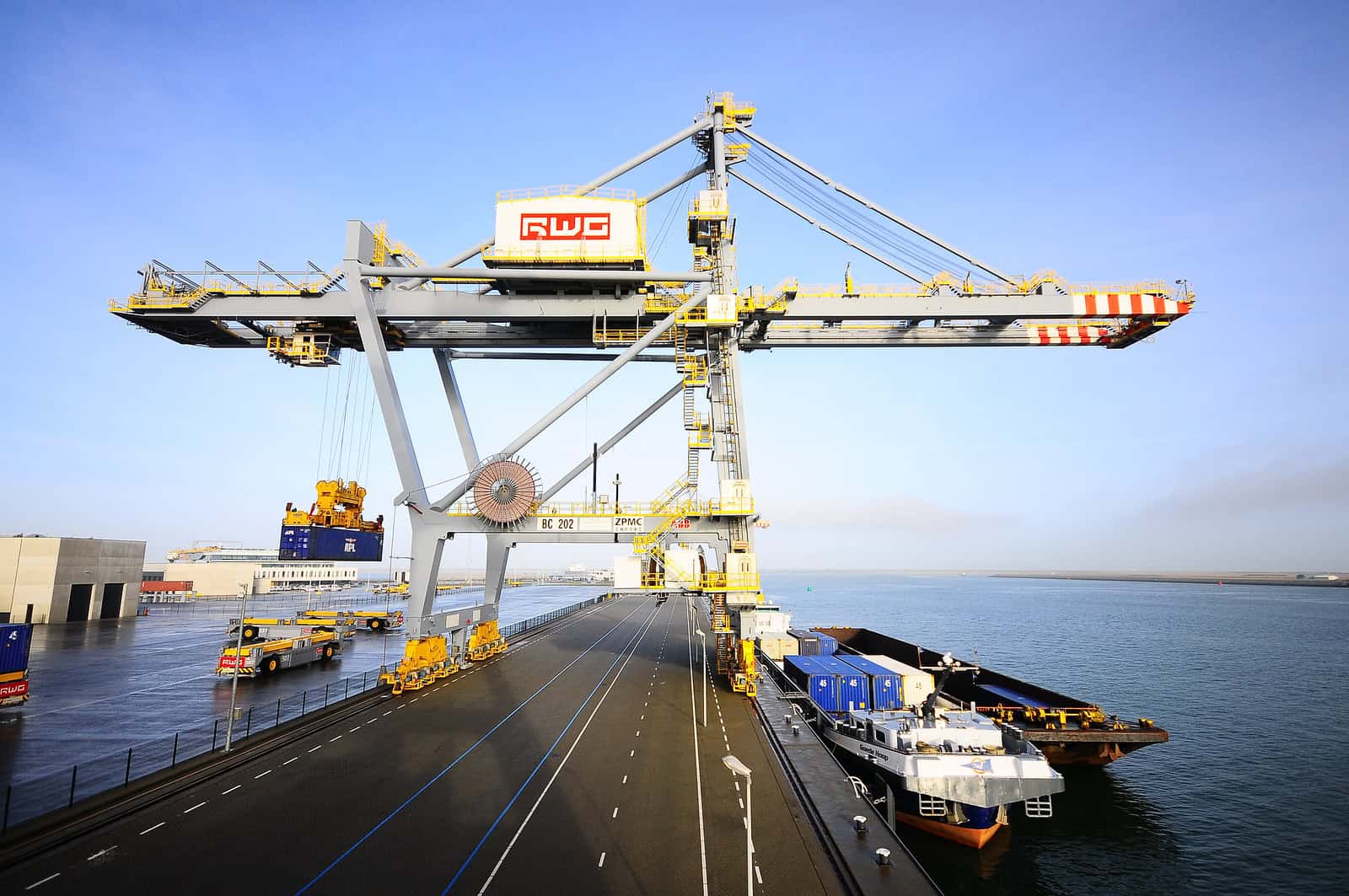
It is based in the global port of Rotterdam, and RWG is highly dependent on its IT infrastructure. The process of loading and unloading containers and transport movements at the terminal are almost entirely automated with the aim of limiting internal transport. This increases the efficiency of RWG’s container terminal and minimizes its carbon footprint. Never before has the automation of a container terminal been taken this far.
Reliable and sustainable
Paul Saraber, Supervisor IT Engineering team and IT Architect at RWG: “Our terminal was designed from the outset with efficiency in mind. From the start of construction of the terminal in the summer of 2012 until its official opening in September 2015, we built the IT infrastructure at the same time. We operate 24 hours a day, 7 days a week. When container ships arrive at the terminal or are about to leave, the time pressure is very high. We simply cannot afford any delays in handling the containers. This means that our IT infrastructure – hardware, software, and services – must be extremely reliable.”
Paul Saraber emphasizes that sustainability is one of RWG’s core values, and that also applies to IT: “It means that we definitely invest in our IT and specialists, but that we certainly don’t spend too much money to achieve our goals.”
Looking for insight
After the container terminal was successfully put into operation, the IT team found the time to take a good look at “what they had actually built.” Paul Saraber: ‘It’s not that we didn’t know what we had built, but we didn’t have direct insight into software usage in particular. From the start of construction to commissioning, changes were made to the original design. This was because we added improvements and innovative solutions during construction. In short, we knew for sure what we were using, but we lacked insight into which software from the test and acceptance environment was still in use and which was no longer in use. We wanted to gain more insight into the actual software usage and be sure that we were using the software in accordance with the software manufacturers’ terms and conditions.”
RWG then wrote to a selected number of Software Asset Management service providers with the aim of selecting a suitable partner based on the tenders.
It’s not a project
Peter van Uden, owner and senior SAM consultant at Quexcel: “We were delighted to receive a call from Paul informing us that RWG had selected us as their preferred partner for Software Asset Management services. Our big advantage is the SAM platform we use. This platform works without agents that need to be installed on the equipment. That way, there is no impact on the IT infrastructure, which is very important for organizations that operate around the clock and have business-critical processes that rely entirely on IT.” Paul Saraber adds: “That’s right, and we were pleasantly surprised that within 48 hours of starting, we had achieved more than 95% completeness in the inventory of hardware and software.”
But a managed service—managed SAM—is more than just taking inventory and researching the results. Peter van Uden continues: “Absolutely. We are here to help and guide the customer. Using the latest data as a starting point, we help RWG optimize their entire IT environment, identify software risks, and save on software and cloud costs. But Software Asset Management is more than just technology. It’s also about people and processes, and we help in all areas. On the technical side, discovering legacy applications, software whose support has expired, vulnerabilities, and many other aspects play an important role. With our managed SAM service and the underlying platform, we are able to help RWG get the most out of their IT environment, improving security, making better use of available resources, and driving innovation at the same time. It is a true collaboration where customer and service provider work together.
Savings
One of the advantages of Software Asset Management is the insights that RWG has gained. Paul Saraber: “Take Microsoft SQL Server as an example. We already knew how many SQL Servers we had in use. We even knew the different editions, but not always the exact version or which SQL Server was covered by a license from one of our software suppliers or which had to be covered by a license from us. That is a risk of non-compliance. But more importantly, by analyzing the current usage data and with Quexcel’s licensing expertise, we were able to jointly set up a business case around the use of SQL Server. This showed that building an SQL Server cluster in active-active mode could give us the much-needed high reliability and availability, while at the same time saving tens of thousands of euros in SQL Server license costs. That’s Managed Software Asset Management as we like to see it.”
Peter van Uden: “This approach applies to all Microsoft software, but also to software titles from other publishers. We continuously monitor the customer’s environment, issue warnings when a critical situation threatens to arise, and help improve the IT environment. Helping customers save on software costs while also helping them achieve their goals is a nice bonus.”
Continuous improvement
One of the characteristics of a managed service is the ongoing collaboration between customer and service provider. Both parties are constantly looking for improvements in technology, processes, and human interaction with the IT environment. Only in this way are customers such as RWG able to innovate and stay ahead of the competition in this era of digital transformation. Paul Saraber concludes: “Software Asset Management is not a one-off project these days. Our customers, our organization, and therefore our IT are constantly changing. We are constantly looking for opportunities for improvement, and we are fortunate to have had a partner like Quexcel for many years to help us with this.”