
Microsoft has announced a regional price increase for specific Azure Virtual Machines and Azure Storage services, effective February 1, 2027.
Depending on the Azure region, prices are expected to increase by 8% to 17%.
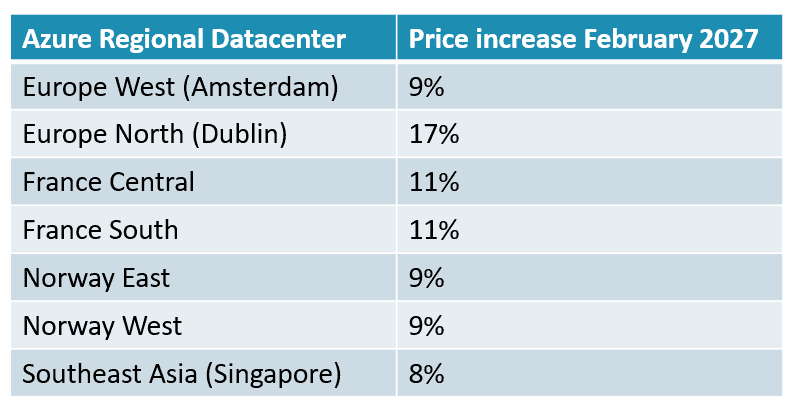
According to Microsoft, these price adjustments are necessary to better reflect regional market conditions, create greater pricing consistency across regions, and support continued investments in hardware and infrastructure.
Exceptions
Not all Azure services and Virtual Machine series are affected by the regional price increase. The following VM series are excluded:
- V1 series : Bv1, D, Ds, F, Fs, G, Gs, L, NP, HCS
- V2 series: Av2, Amv2, Dv2, Dsv2, Fsv2, Lsv2
- V7 series: Dsv7, Ddsv7, Dlsv7, Dldsv7, Esv7, Edsv7
Please note that several V3 series Virtual Machines, including the Dv3, Dsv3, Ev3, and Esv3 series, are scheduled for retirement on November 15, 2029. In addition, new reservations for V1 and V3 series Virtual Machines will no longer be available for purchase.
In addition to Virtual Machines, several Azure Storage offerings are excluded from the price increase. These include, but are not limited to:
- Azure Container Storage
- Azure Managed Lustre
- Azure NetApp Files – Cross Region Replication SKU
- Blob Features
- Change Feed
- General Block Blob
- Import/Export
- Queues
- Queues v2
- Standard Page Blob
- Storage Actions
- Storage Bandwidth
- Storage Discovery
- Tables
- Transaction Optimized SKU
What Can You Do?
Rather than simply accepting the higher costs, there are several steps organizations can consider to mitigate the financial impact of the price increase:
- Consider moving workloads to a lower-cost Azure region. Keep in mind that moving workloads between regions may affect latency, data residency requirements, and application performance, while the migration itself may also involve additional costs.
- Evaluate alternative Virtual Machine types or sizes. A different VM series or configuration may offer a more favorable price-performance ratio, provided it meets your organization’s technical and business requirements.
- Purchase Azure Reservations for predictable workloads. For Virtual Machines that run consistently, reservations can significantly reduce the underlying compute costs compared with pay-as-you-go pricing.
- Use Azure Hybrid Benefit for Windows Server where applicable. For eligible Windows Server workloads, organizations can use qualifying Windows Server licenses with Software Assurance or subscription licenses instead of paying the full Windows Server license cost through the Azure meter. This can further reduce the cost of running Windows Server VMs in Azure.
Combining the right VM configuration, region, reservations, and Azure Hybrid Benefit can therefore provide substantial opportunities to offset some of the impact of the upcoming Azure price increases.
What About Existing Reservations?
Based on the information available as of October 16, 2026, Azure Reservations purchased before February 1, 2027 are not expected to be affected by the price increase. The price agreed upon when purchasing the reservation will continue to apply for the duration of the reservation term.
This may provide organizations with predictable Azure workloads an opportunity to review their reservation strategy before the new regional pricing takes effect.
Need Help?
Azure pricing optimization involves more than simply selecting the lowest-priced Virtual Machine. Region, VM type and size, workload utilization, reservation terms, Azure Hybrid Benefit, and licensing requirements can all influence the actual cost of running a workload in Azure.
If you would like assistance assessing the impact of the upcoming Azure price changes or optimizing your Microsoft licensing and Azure costs, please contact one of the licensing specialists at Quexcel.