
Too Few or Too Many Licenses
Before discussing management approaches, we first need to answer a crucial question: which situation is worse—having too few licenses or too many?
In the case of underlicensing—also known as overuse or incorrect use—the software vendor will certainly have an opinion. It is not allowed, and a shortfall can result in a forced purchase under unfavorable conditions, often at higher prices. This leads to unexpected costs and may also have legal consequences.
Overlicensing, however, can be just as problematic. Excess licenses often result in hidden, recurring costs that provide no value. They put unnecessary pressure on IT budgets and reduce the funds available for product development, customer support, or employee training.
In both cases, the conclusion is the same: the situation is unnecessary and risky. Gaining and maintaining control over software usage and costs is therefore critical.
IT Asset Management
The set of processes and measures designed to provide control and visibility over a digital environment is known as IT Asset Management (ITAM). There is even an international standard for this discipline: ISO/IEC 19770 1:2017 – Information Technology — IT Asset Management.
A fundamental principle of ITAM is simple: you cannot improve what you do not understand. And you cannot understand what you do not measure. Measuring leads to insight, and insight creates opportunities.
Doing It Yourself
Organizations can, of course, choose to manage Software Asset Management internally. In many cases, various tools are already in place that map parts of the IT environment. However, the data these tools provide is often fragmented, incomplete, or out of date.
In addition, ITAM responsibilities are frequently assigned to someone for whom this is not a primary role. Time constraints can then lead to decisions based on inaccurate data or incorrect interpretations. Keeping licensing knowledge up to date is already a challenge in a rapidly evolving IT market. And when an audit arises, this situation often results in stress and uncertainty.
Investing in a SAM Tool
If an organization decides to invest in a SAM tool—such as Flexera, Snow, ServiceNow, or Octopus Cloud—it acquires professional tooling to work in a more structured way. These tools typically provide a complete inventory, allow contracts to be captured, and offer reporting based on the current license position.
Based on this information, smart decisions can be made. We deliberately emphasize the word “can”, because success depends heavily on the availability of time and expertise. Maintaining up to date licensing knowledge is complex and time consuming. In addition, training and sometimes certification are required to fully and effectively use these tools.
Managed IT Asset Management
At first glance, a fully managed IT Asset Management service may seem unnecessary. Common statements include: “We know this ourselves”, “We have built excellent scripts” or “We have the license knowledge in house”. While these statements are often true individually, combining all of them consistently proves difficult in practice.
With a managed ITAM service, the provider acts not only as an execution partner but also as a trusted advisor. Knowledge and time are continuously applied to deliver periodic, KPI driven, actionable insights. These insights enable informed decision making and reduce risk. It is not merely an extension of services, but a close collaboration in which ITAM functions as an integral extension of the organization.
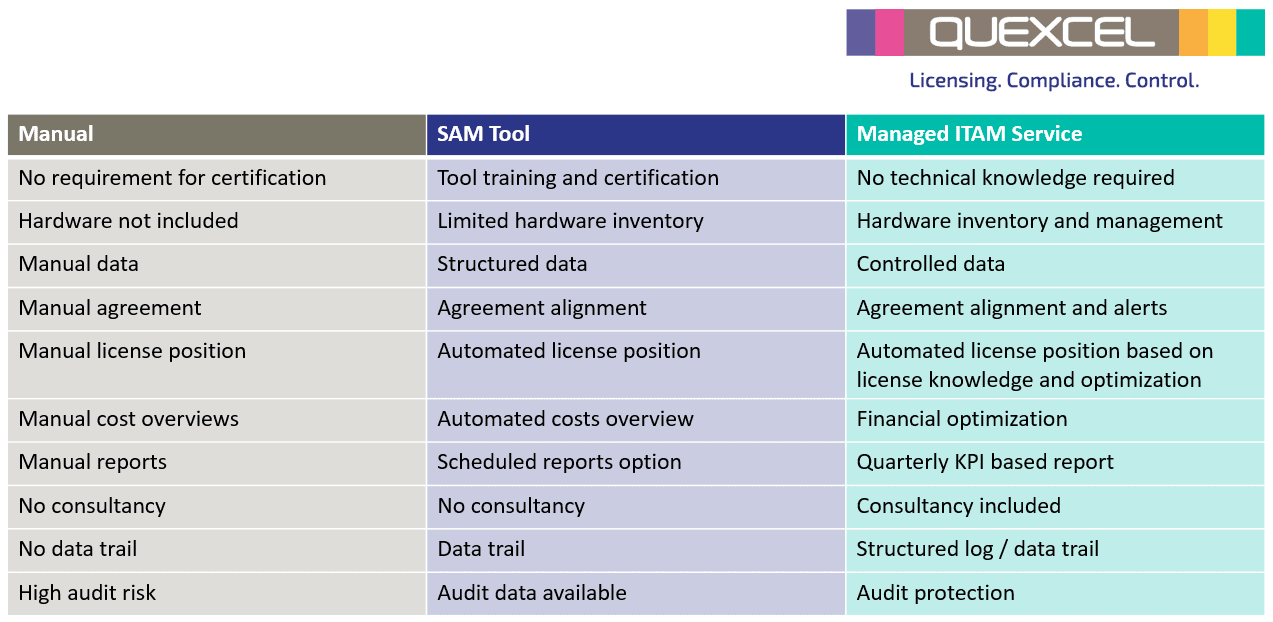
It will come as no surprise that we at Quexcel—provider of a managed IT Asset Management service—strongly advocate this approach. In the table below, we compare the key characteristics of the three options discussed: doing it yourself, investing in tools, or engaging a specialized expert.
Are you curious about what is best for your organization? Please do contact us for a chat about IT Asset Management.